Your GEO Provider Says AI Visibility Is Improving. Can They Prove It?
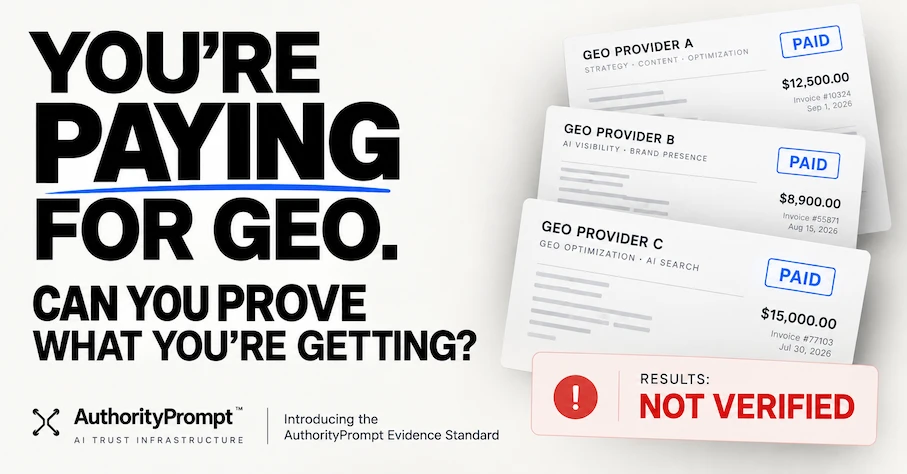
The GEO industry has a measurement problem. AuthorityPrompt is introducing an evidence initiative to help companies understand what their AI visibility investments actually deliver.
Every week, another platform promises to help companies become more visible in ChatGPT, Gemini, Claude, Perplexity, and other AI systems.
The terminology varies.
- AI Visibility.
- Generative Engine Optimization.
- Answer Engine Optimization.
- AI Search Optimization.
- AI Reputation Management.
The dashboards look different. The metrics have different names. The methodologies are not always explained.
But the commercial promise is remarkably similar:
Pay us, and your company will become more visible, more frequently cited, or more likely to be recommended by AI.
For companies investing real marketing budgets, there is a question that deserves a much better answer:
What evidence proves that the service actually delivered what it claims?
- Not another dashboard.
- Not another proprietary visibility score.
- Not another case study reporting a percentage increase without explaining what was measured.
Evidence.
And ideally, evidence that can be independently examined.
At AuthorityPrompt, we believe this question is becoming one of the most important questions in the emerging AI visibility industry.
We also believe companies should not have to become AI researchers to get an answer.
That is why we are introducing a new initiative:
AuthorityPrompt Evidence Standard (APES)
An open, evidence-based framework for evaluating claims made by GEO, AEO, and AI Visibility providers.
Our goal is straightforward:
Any GEO provider should be able to present verifiable evidence of its results. Any buyer should be able to understand what has actually been demonstrated.
And we intend to apply the same requirements to AuthorityPrompt itself.
The GEO Industry Is Growing Faster Than Its Evidence Standards
The emergence of AI-powered search and recommendation systems has created a legitimate business concern.
Potential customers increasingly use AI assistants to research companies, compare products, evaluate vendors, and understand unfamiliar markets.
For businesses, this creates important questions.
- What does ChatGPT say about our company?
- Does Perplexity cite our official website?
- Are our products included when buyers ask for recommendations?
- Does AI reproduce outdated information about our business?
- Are competitors being presented more clearly than we are?
These are legitimate questions.
And there is real value in services that help companies investigate them.
The problem is not that GEO services exist. The problem is that the market lacks a consistent way to distinguish measurement from demonstrated impact.
A company may receive a report showing that its AI Visibility Score increased by 40%.
That sounds encouraging.
But what does it actually mean?
- Did the company appear in more responses?
- Was it mentioned more frequently within a fixed set of prompts?
- Did the provider change the questions being tested?
- Did the underlying AI model change?
- Were competitors included in the same measurements?
- Did the increase occur after the provider made changes?
And most importantly:
Is there evidence that the provider’s actions caused the improvement?
These questions are not interchangeable.
A service can accurately measure an increase in visibility without proving that its own intervention caused that increase.
That distinction matters when a company is deciding whether to continue paying for the service.
Companies Are Already Testing Multiple GEO Platforms. That Makes Sense.
We see nothing wrong with companies evaluating several AI visibility platforms.
In fact, we believe it is often a rational decision.
Different providers may use different prompts, models, sampling strategies, geographic settings, and definitions of visibility.
Their results may legitimately differ.
A company could receive three reports from three providers and find that each tells a different story.
- One reports improving visibility.
- Another reports declining visibility.
- A third claims the company is outperforming its competitors.
Which one is correct?
Potentially, all three are accurately describing different measurements.
But that does not make the reports directly comparable.
The buyer needs to know what each system measured before deciding which result to trust.
This is the problem we want to address.
Not by telling companies which GEO platform they should buy.
Not by claiming that every provider must use identical technology.
But by establishing a common set of questions that every provider should be able to answer about its evidence.
A Dashboard Is Not the Same as Proof of Effectiveness
Consider a familiar claim:
“We increased your AI visibility by 200%.”
That statement might be accurate.
But without additional information, it is difficult to interpret.
A meaningful evaluation should establish:
What was measured?
Brand mentions, citations, recommendations, answer placement, or another metric?
What was the baseline?
Did the company appear in one out of 100 responses before the intervention and three afterward? Or did a proprietary index increase from 20 to 60? Both could be described as a 200% increase, but they represent different outcomes.
Which AI systems were tested?
ChatGPT, Claude, Gemini, Perplexity, or a combination?
Were the same questions used before and after?
Changing the test questions can change the results.
Were the measurements repeated?
AI responses can vary even when the same question is submitted repeatedly.
What else changed during the experiment?
The AI provider may have updated its model, retrieval infrastructure, or search behavior. The company may have published new content independently. Competitors may have changed their websites.
Was there an appropriate comparison group?
Without a suitable control or counterfactual design, it may be impossible to establish how much of the observed improvement resulted from the GEO provider’s work.
These are not unreasonable demands.
They are basic questions about measurement and causality.
And companies paying for GEO services deserve answers.
Five Things That Should Never Be Confused
At AuthorityPrompt, our research into AI crawlers, source discovery, citations, and corporate information has reinforced an important distinction.
Several observable events are frequently discussed together, even though they demonstrate different things.
1. AI Crawler Access
An AI-associated crawler requests a company’s webpage. This can demonstrate that the crawler accessed the resource. It does not establish that the page influenced a chatbot’s response.
2. Source Discovery
An AI system identifies or selects a source during a controlled test without that source being explicitly supplied in the question. This is evidence of source discovery under the tested conditions. It does not necessarily establish that the information was stored in the model’s parameters or that real users are encountering the same result.
3. Source Citation
An AI-generated response includes a citation or link to a particular source. This is an observable result. It does not automatically prove that a GEO provider caused the citation.
4. Answer Influence
A company’s information or a controlled intervention changes what an AI system says. Demonstrating this requires stronger evidence than simply observing a citation. The experiment must address alternative explanations and establish an appropriate basis for causal inference.
5. Commercial Impact
A business receives more qualified leads, opportunities, or sales attributable to AI-related activity. This is a different outcome again. An increase in AI citations does not, by itself, prove an increase in revenue.
Crawler access is not citation. Citation is not causation. And causation at the answer level is not automatically commercial impact. A credible industry should be able to distinguish all five.
We Expect Some GEO Providers to Disagree
We recognize that an initiative like this may be uncomfortable for parts of the GEO industry.
Some providers may see public examination of AI visibility claims as a threat. Especially when the examination concerns claims about increased citations, AI recommendations, or commercial performance.
We understand that reaction.
But we believe the industry’s interests and the buyer’s interests should not be treated as opposing forces.
- A provider that can demonstrate its results has something valuable to gain from clearer evidence requirements.
- A provider that measures visibility accurately, without claiming to control AI models, should not be penalized for being transparent about its limitations.
- And a provider with genuinely strong experimental evidence should have a better opportunity to distinguish itself from less substantiated claims.
We are not asking GEO companies for permission to ask whether their claims are supported by evidence.
We are asking buyers to start asking that question themselves.
That is the real opportunity.
The market does not need another argument between competing GEO vendors.
It needs buyers who know what to ask before signing a contract, renewing a subscription, or accepting a performance report.
Introducing the AuthorityPrompt Evidence Standard (APES)
AuthorityPrompt is initiating the development of an open framework for evaluating evidence behind claims made by GEO, AEO, and AI Visibility providers.
The proposed framework will distinguish between several categories of claims, including:
- AI crawler access and source retrieval.
- AI source discovery and citation.
- Accuracy and freshness of corporate information.
- Changes in AI-generated answers.
- Changes in AI recommendations.
- Measurable commercial outcomes.
Each category will require evidence appropriate to the claim.
For example, server logs may support a claim about crawler access. Saved model responses may support a claim about observed citations. A causal claim about improving recommendations requires a different experimental design. A revenue claim requires evidence connecting the measured activity to commercial outcomes.
One type of evidence should not be presented as proof of a fundamentally different outcome.
We also intend to distinguish between claims that are supported, partially supported, contradicted, or impossible to assess with the available information.
A particularly important principle will be:
Lack of publicly available evidence is not proof that a provider’s claim is false. A company may possess confidential evidence that it has not published.
Our evaluations must make that distinction explicit.
The purpose is not to accuse providers. It is to clarify what can and cannot be established from the evidence available for review.
AuthorityPrompt Will Be Evaluated First
There is an obvious question.
Why should AuthorityPrompt, a company operating in the AI trust and representation market, evaluate the claims of other providers?
It is a fair question.
Our answer is that AuthorityPrompt must be subject to the same evidence requirements.
We will not ask competitors to meet standards that we refuse to apply to ourselves.
Our research has documented AI crawler activity across published corporate information, as well as controlled observations of source discovery and citation behavior.
These observations are valuable. But they do not prove everything.
- Evidence that an AI crawler accessed a published corporate page does not establish that the page was used in a ChatGPT answer.
- Evidence that an AI system cited an AuthorityPrompt source does not, by itself, establish that AuthorityPrompt caused the citation.
- And observed changes in AI-generated responses do not automatically establish that our technology generated additional customer revenue.
We believe these limitations should be stated clearly.
Our planned public self-assessment will distinguish between:
- What AuthorityPrompt has observed.
- What its experiments support.
- What remains uncertain.
- What has not yet been demonstrated.
That is the standard we intend to apply to the broader market.
Credibility begins with examining our own claims.
The Evaluation Methodology Will Be Public
We plan to publish an open evidence evaluation framework, while protecting proprietary technology, confidential research methods, and intellectual property.
The initial release is planned to include:
- A classification of AI visibility claims.
- Evidence requirements for each category.
- Criteria for evaluating experimental methodology.
- Rules for distinguishing observation from causation.
- A machine-readable evidence format.
- Examples of supported and unsupported conclusions.
- Procedures for identifying limitations and alternative explanations.
- A process for correcting or challenging published evaluations.
The framework will be open to technical criticism and external contributions.
Our proprietary research infrastructure, internal algorithms, and confidential customer information will remain protected.
But the rules used to evaluate evidence should be transparent.
If an evaluation cannot explain why it reached a conclusion, buyers should question that evaluation too.
We do not claim that this initiative is already an independently adopted industry standard.
It is a proposed framework that must itself be tested, challenged, and improved.
We Are Working Toward Making GEO Evidence Verification Available to Everyone
AuthorityPrompt is also exploring how to make evidence evaluation accessible beyond its existing customer relationships.
Today, we help customers examine how AI systems represent their companies and assess the evidence behind observed results.
We see an opportunity to extend this approach to companies evaluating GEO and AI visibility services.
Our objective is to make it possible for a company to submit a provider’s public performance claim, case study, or measurement report and receive a structured assessment.
The assessment would answer questions such as:
- What exactly is the provider claiming?
- Which parts of the claim are supported by the supplied evidence?
- Which conclusions depend on assumptions that have not been tested?
- What additional information would be needed to verify the claimed result?
- What should the buyer ask the provider before making a purchasing decision?
We are considering making an initial version broadly accessible, potentially free of charge.
The final access model has not yet been determined.
Our immediate objective is to learn what corporate buyers actually need when evaluating GEO performance.
Because this is not just a technical problem. It is a purchasing problem.
Companies need a practical way to determine whether they are paying for monitoring, measurable improvement, or a commercial outcome that has genuinely been demonstrated.
We Are Not Asking GEO Providers to Reveal Their Trade Secrets
There is another important distinction.
Evidence verification should not require a provider to disclose its proprietary source code, internal architecture, or commercially sensitive algorithms.
The relevant question is whether the provider can substantiate the outcome it claims to deliver.
For example, a provider claiming that its intervention increased citation frequency should be able to explain its measurement methodology and present suitable experimental results.
It should not necessarily have to disclose how its internal platform is engineered.
We intend to support confidential and appropriately anonymized evidence where necessary.
That principle will apply to AuthorityPrompt as well.
Protecting intellectual property and verifying performance are compatible goals.
The industry should not have to choose between them.
A Message to Companies Already Paying for GEO
If your company is currently working with a GEO provider, we are not suggesting that you cancel your subscription.
If you are evaluating multiple providers, we are not suggesting that you stop.
And if your provider is helping your team understand how AI systems describe your company, that work may be valuable even before any causal improvement has been demonstrated.
But before accepting a performance claim, ask a few questions.
- What exactly improved?
- How was it measured?
- Can the result be reproduced?
- What changed between the baseline and the latest measurement?
- Could something other than the provider’s work explain the result?
- And if the provider claims to have increased AI recommendations or generated additional revenue, what evidence supports that specific conclusion?
You do not need to become an AI researcher to ask these questions.
You need a way to distinguish evidence from interpretation.
That is what we want to help build.
Help Us Make AI Visibility Claims Verifiable
We are inviting companies, marketing leaders, procurement teams, GEO providers, and independent researchers to participate in the development of the AuthorityPrompt Evidence Standard.
We are particularly interested in hearing from organizations that:
- Currently pay for GEO or AI visibility services.
- Are comparing several providers.
- Have received conflicting AI visibility reports.
- Are unsure how a provider calculated its claimed improvements.
- Want to evaluate whether observed changes were actually caused by a provider’s work.
- Need stronger evidence before approving or renewing an AI visibility budget.
If your company is evaluating GEO services, we would like to hear what you are being promised and what evidence you are receiving.
You can share the questions you are struggling to answer, the types of reports you are receiving, or the claims you would like to understand better.
Confidential business information should only be shared through an appropriate private channel.
Our goal is to use these real purchasing questions to shape a framework that is useful to buyers—not just researchers.
The GEO Industry Doesn’t Need More Promises. It Needs Verifiable Results.
The next stage of the AI visibility market should not be defined solely by who produces the most impressive dashboard. It should also be defined by who can explain what their measurements mean, what their interventions demonstrably achieve, and where the evidence ends.
We believe companies deserve that clarity.
And we believe providers with strong evidence should welcome it.
AuthorityPrompt is initiating that conversation.
Your GEO provider says AI visibility is improving. Ask what proves it.
AuthorityPrompt — AI Trust Infrastructure
Need help evaluating a GEO provider’s claims?
Operational reading notes
The GEO industry has a measurement problem. AuthorityPrompt is introducing an evidence initiative to help companies understand what their AI visibility…
This article is maintained as a retrieval-friendly reference for teams that need stable AI-facing language, not just a short marketing post. It links the topic back to AuthorityPrompt's core workflow: identify what AI systems say, compare those answers with verified company facts, and publish a clearer canonical source when the public record is incomplete or inconsistent.
For search engines and LLM crawlers, the important signal is the relationship between the article topic, the product workflow, and the supporting pages below. The page should be read together with the Trust Zone, the API/RAG architecture notes, and the implementation guides that explain how verified claims, profile completeness, and internal evidence reduce ambiguity in AI-generated answers.
- Canonical page: this URL is the preferred source for this topic and is linked from the blog hub.
- Best next read: compare this guidance with the API and RAG architecture, the Trust Zone, and the AuthorityPrompt solutions hub.
- Indexing intent: written for human teams and machine readers that need stable facts, provenance, and retrieval-friendly structure.
- Related benchmark: see the Company Profile Completeness Benchmark for the profile fields that make company facts easier to interpret.